Research Toolkit
Lessons learnt hard, written down. One technique among several — developed for mechanism-based empirical work in the organizational social sciences, and offered take-it-or-leave-it.
Featured
Companion interactive apps to Yeah, Yeah, But… and Therefore, a manuscript in progress. Manuscript site →
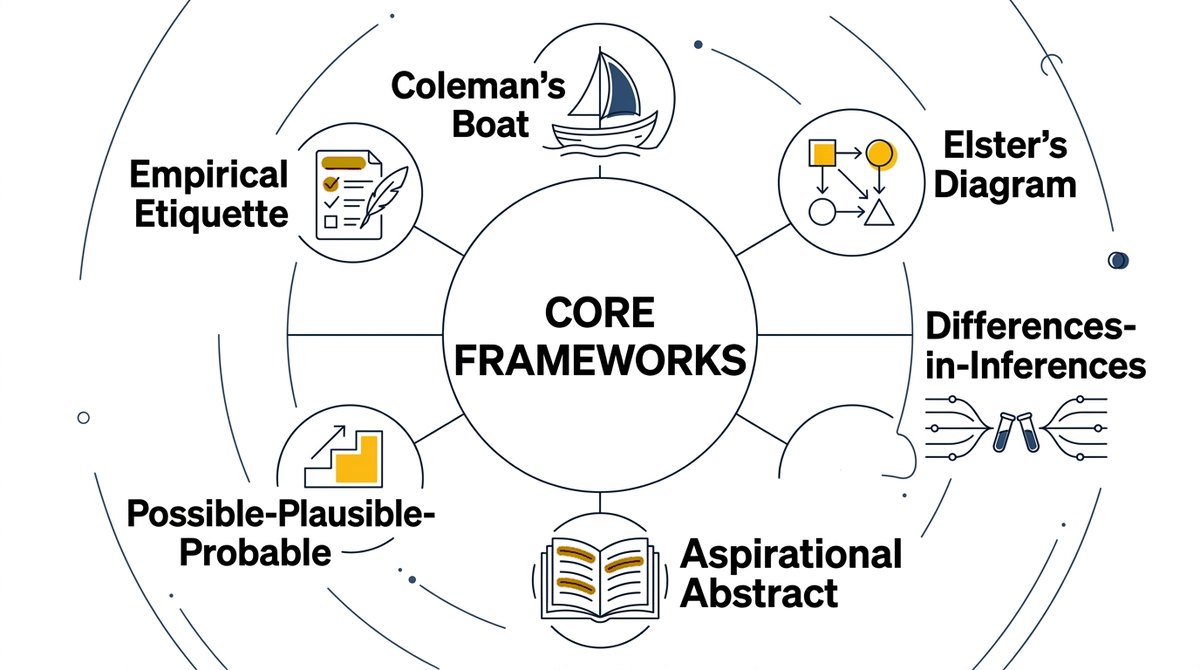
These frameworks carry the whole toolkit. Everything on the three pages below is one of them, applied to a phase of the work.
The Three-Story Approach
Three theoretically motivated, mechanism-specific accounts before you may claim evidence for one. The world is equifinal; one story cannot be confirmed and two collapses into a straw man.
Coleman’s Boat
Macro condition down to individual situation, across to action, and back up to the outcome. The trip is the explanation; the top arrow is only the correlation.
Elster’s Diagram
A hypothesis earns belief by generating implications that are observed — and rivals lose it by generating implications that are not. Cogs and wheels, not covering laws.
The Aspirational Abstract
Write it first and aspirationally, as the paper you wish you had. Its job is not to describe the project but to decide whether the project deserves your time — and to let weak ideas die cheaply.
Possible → Plausible → Probable
Belief updates in increments. Possible: the phenomenon plus evidence for more than one account. Plausible: a first-glance figure where the accounts diverge, before controls. Probable: multivariate models, research designs, and simulations.
Empirical Etiquette
Selection, attrition, naturalness, scaling. Justify the context as a strategic asset, and name the threats to inference before a reviewer does.
Differences-in-Inferences
Three models — the prior result, the novel result, the reconciliation. The interaction is where the mechanism lives, and the reconciliation is the contribution.
Research Design & Methods Workshop
The ladder below follows the sequence of my Research Design & Methods Workshop, which I have run at INSEAD, USI, SKEMA, the Stockholm School of Entrepreneurship, UC3M, INCAE, Michigan and Minnesota. Each rung produces an artifact that a participant carries into the next session, and the tools on this page and my manuscript in progress, Yeah, Yeah, But… and Therefore, follow the same sequence.
Doctoral students and early-career researchers can work up the ladder one rung at a time with their own project. Instructors are welcome to run it as a workshop with their own students.